Our Harvard Connection
The Harvard method of negotiation was developed by researchers at MIT, Tufts and Harvard.
From legal, psychological, anthropological and substantive aspects, an integrated approach has emerged whose basis is described in “Getting to Yes,” the worldwide bestseller that can be seen as the bible of the constructive negotiator.
The origins of Harvard negotiating
Roger Fisher is the founder of the Harvard Method. After serving in World War II, he worked on the Marshall Plan in Paris before arguing cases as a lawyer before the U.S. Supreme Court. He also advised on international disputes. After losing many of his friends in the war and seeing so much costly litigation as a litigator, Fisher became intrigued by the art and science of managing our disputes. Fisher and his students at the Harvard Negotiation Project (founded in 1979) began interviewing people who were known to be skilled negotiators to understand what made them effective. He began his studies by asking, “What advice could I give both parties in a dispute that would be helpful and lead to better results?” This work eventually led to Getting to YES.
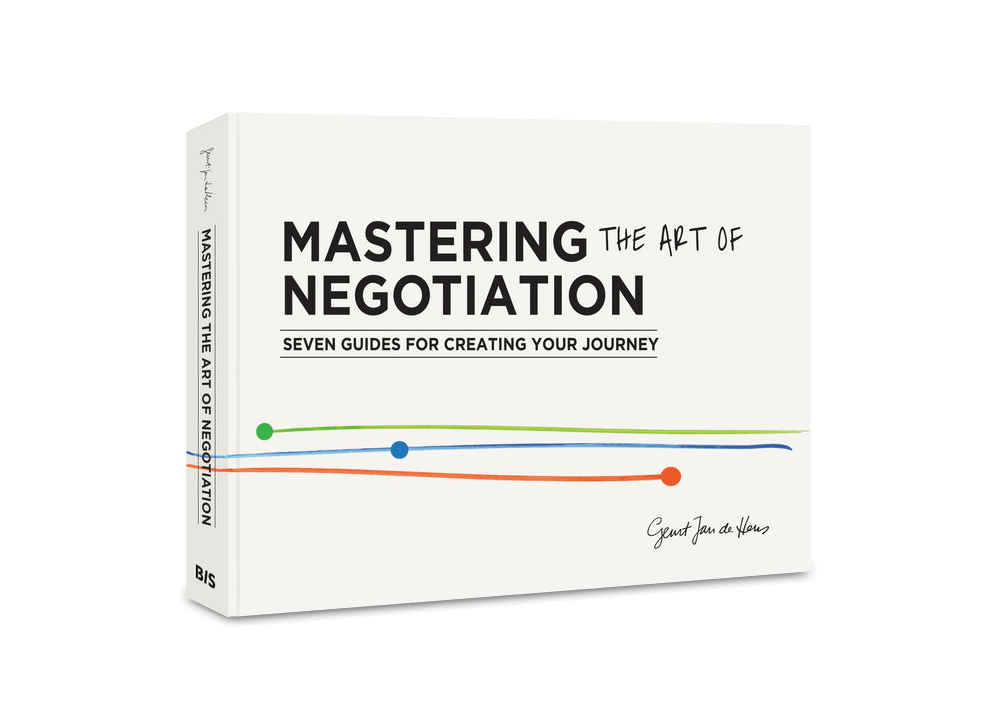
You may be familiar with the original principles of the method such as: separate the people from the problem, focus on interests, look for win-win solutions and use objective criteria in distribution. Frits Philips Jr., John Routs and Joep Laeven helped introduce this approach to the Netherlands and we have expanded and deepened it. You can read about our approach in the book Mastering the Art of Negotiation (Geurt Jan de Heus).
Negotiation is a structured way of reaching decisions together. Coming up with solutions together, even when there is disagreement. You can use it to prevent and resolve conflicts. It’s daily business! Mediation (a negotiation supported by a third party), the Mutual Gains Approach (MGA), Constructive Bargaining…. they can all be traced back to the source: the Harvard method of negotiation.
View our services
Collaboration becomes more important
Especially now, being able to negotiate is important. As we increasingly want and need to collaborate in a VUCA (volatility, uncertainty, complexity, ambiguity) environment, complexity increases in all kinds of situations involving many parties, many interests and many risks. We want “together,” the call for “transparency” is growing, new business models are being sought. Boundaries are blurring not only between countries, but also between organizations and within organizations themselves (de-funding). ‘Social innovation’, ‘knowledge circulation’, ‘hybrid partnerships’, ‘co-creation’,’the WEconomy’, ‘eco-systems’ are a sign of this.
Society and organizations are becoming “flatter” and less hierarchical. And then if we want to work more “together,” more broadly, with multiple parties; how do we share the gains and losses, the joys and the burdens? Who pays decides? Is the customer (always) king? Does the power of the strongest, the biggest mouth prevail? Personal leadership also takes on a different coloring if you want to reach good decisions with others from negotiating principles. Harvard negotiating is especially relevant now, and honing your negotiating skills is key.
When William Ury was recently interviewed by the Wall Street Journal, this question was asked, “What’s changed since that book came out in 1981”? Ury saidi: “I recently asked a group of business executives, take the ten most important decisions you made in the last year. How many came out of negotiations? They said nine to ten were acts of negotiation. It has become the pre-eminent process for making decisions at work as well as at home and in the community. The basic form of organisation has shifted from very hierarchical, where people on top give orders and those below carry them out, to flatter organisations that resemble networks. The form of decision-making has shifted from vertical to horizontal, and that’s essentially another name for negotiation”.
Our book: Mastering the Art of Negotiation
‘Mastering the Art of Negotiation’ goes beyond making business deals: it is about managing decision-making processes, solving problems together, leading and collaborating, creating partnerships, and dealing with games people play. The book describes seven principles that will help you deal with negotiations in complex and uncertain situations.
View the book